Natural Hazards Fundamentals
Understanding risk, vulnerability, and hazard classification
- Define natural hazard, risk, and vulnerability
- Classify hazards into tectonic, weather, and climate types
- Explain physical and human factors affecting hazard impact
- Compare hazard impacts in LICs vs HICs
Global Hazard Distribution
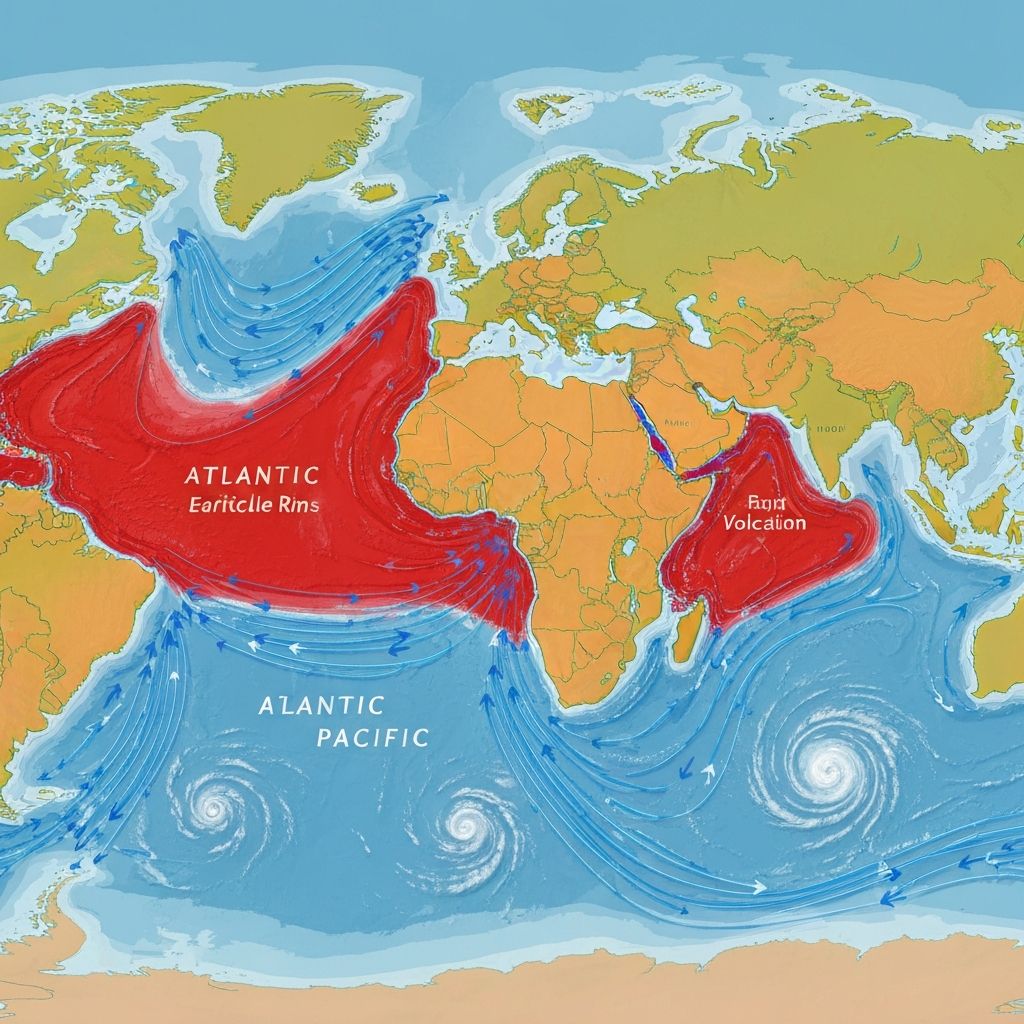
Legend
Types of Natural Hazards
Tectonic
Earthquakes, volcanoes, tsunamis
Weather
Tropical storms, floods, droughts
Climate
Long-term changes like global warming
Other
Wildfires, landslides, avalanches
Key Definitions
An extreme physical event that poses a risk to people and property. It only becomes a hazard when it threatens human life or assets.
Example: An earthquake in an unpopulated desert is not a hazard; the same earthquake under a city is.
The probability of a hazard occurring multiplied by its potential impact. Risk = Probability × Impact.
Example: A flood-prone area with expensive properties has high risk even if floods are rare.
The susceptibility of a population to damage from a hazard. Includes exposure, sensitivity, and adaptive capacity.
Example: A poorly-built school in an earthquake zone has high vulnerability.
The ability of a community to recover quickly from a hazard event. Includes infrastructure, governance, and social networks.
Example: Japan rebuilds rapidly after earthquakes due to high resilience.
Factors Affecting Hazard Impact
Physical vs Human Factors
| Factor | Physical Factors | Human Factors |
|---|---|---|
| Magnitude | Earthquake strength (Richter scale) | Population density in affected area |
| Location | Distance from fault line or volcano | Building standards and construction quality |
| Timing | Time of day (day vs night) | Level of economic development (LIC vs HIC) |
| Frequency | How often events occur | Emergency services and infrastructure |
| Duration | How long the event lasts | Preparedness and warning systems |
Why Impact Varies: LICs vs HICs
LICs (Higher Casualties)
- •Poor building standards - collapse easily
- •Limited emergency services
- •Less developed warning systems
- •Fewer resources for recovery
HICs (Higher Economic Cost)
- •Earthquake-resistant buildings
- •Well-funded emergency response
- •Advanced warning systems
- •Insurance and rapid rebuilding
Grade 8/9 Tip: Always consider BOTH physical magnitude AND human vulnerability when assessing hazard risk in exam answers.
Impact Severity Scale
Impact Severity Scale
Minor
Local damage
Moderate
Regional impact
Severe
Major damage
Catastrophic
National crisis
Extreme
International response
Exam Practice
A magnitude 7.0 earthquake occurs in two locations: (1) Tokyo, Japan (HIC), population 14 million, earthquake-resistant buildings; (2) Port-au-Prince, Haiti (LIC), population 3 million, poor building standards. Explain why Haiti will likely experience higher casualties despite smaller population. [4 marks]
Test Your Knowledge
A tsunami wave hits a coastal village. What type of hazard is this?
Key Terms Flashcards
- 1.Natural hazards are extreme physical events that threaten people and property
- 2.Risk = Probability × Impact; Vulnerability determines how badly a population is affected
- 3.Four main types: Tectonic, Weather, Climate, and Other
- 4.LICs often have higher casualties; HICs often have higher economic costs