Earthquakes
Causes, distribution, impacts and responses
- Explain what an earthquake is and where earthquakes are found globally.
- Distinguish clearly between the focus and epicentre, and explain how focus depth and distance from the epicentre affect earthquake intensity.
- Explain how earthquakes occur at constructive, destructive and conservative plate margins.
- Describe and classify the primary and secondary effects of earthquakes.
- Explain and evaluate immediate and long-term responses using your LIC/NEE and HIC earthquake case studies.
What is an earthquake?
An earthquake is a sudden, violent shaking of the Earth's crust caused by a rapid release of energy when rocks break or slip along a fault line.
Plates are constantly moving; when they become stuck, stress builds up until the rocks eventually snap or move, releasing energy as an earthquake.
Focus and Epicentre
KEY EXAM CONTENT: You must be able to distinguish between the focus and epicentre, and explain how depth and distance affect intensity.
Click each term to reveal its meaning:
Focus (hypocentre)
Epicentre
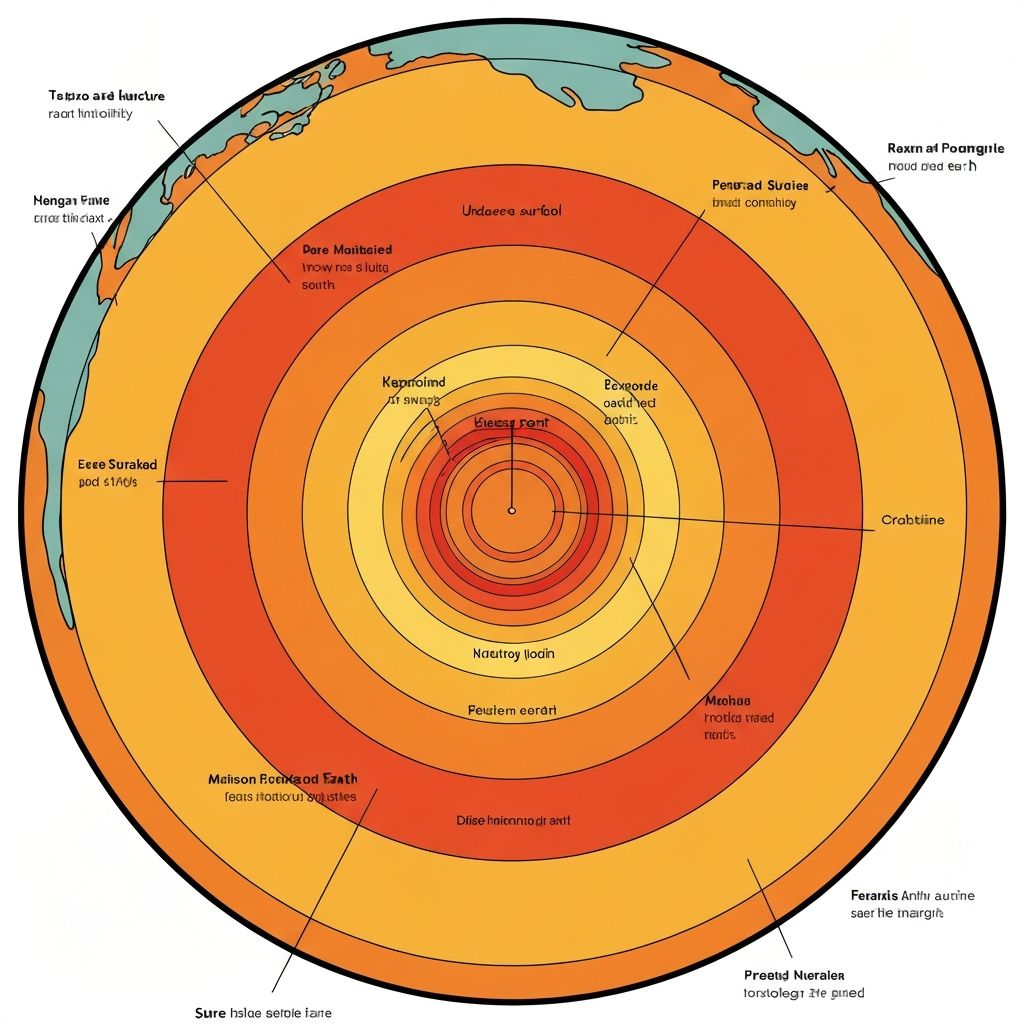
How focus depth and distance affect intensity
Use this as your main explanation framework instead of wave types.
Shallow-focus (0-70 km)
- Focus close to the surface.
- Seismic energy travels a short distance, so little energy is lost.
- Shaking is usually very strong near the epicentre, often causing severe damage if it hits a populated area.
Intermediate-focus (70-300 km)
- Energy travels further before reaching the surface.
- Shaking is less intense at any one place than a shallow quake of the same magnitude, but can be felt over a wider area.
Deep-focus (300-700 km)
- Focus far below the surface, usually in subduction zones.
- A lot of energy is absorbed by rocks on the way up, so shaking at the surface is weaker, even though total energy released can be large.
Distance from the epicentre
- Shaking is strongest at the epicentre and decreases with distance because energy spreads out and weakens as it travels.
- Settlements close to the epicentre are more likely to experience intense shaking, building collapse and high casualties, especially in LICs with weaker construction.
- Further away, people may still feel the quake but with less damage, unless local ground (e.g. soft sediments) amplifies the shaking.
Global distribution of earthquakes
Earthquakes mostly occur in long narrow belts that match the edges of tectonic plates:
- Around the edge of the Pacific Ocean ("Ring of Fire").
- Along mid-ocean ridges such as the Mid-Atlantic Ridge (constructive margins).
- Along major mountain belts such as the Alps and Himalayas (destructive margins).
- Occasional earthquakes also occur in the middle of plates along old fault lines (intraplate earthquakes), but these are less common.
How plate margins cause earthquakes
Click each plate margin to see how earthquakes are generated.
Constructive (divergent) margins
Destructive (convergent) margins
Conservative (transform) margins
Measuring earthquake size and intensity
You only need a basic idea here for GCSE.
Magnitude
How much energy is released by the earthquake, measured on scales such as the moment magnitude scale (Mw).
Intensity
How strong the shaking feels and how much damage occurs at a location. This depends on:
- Magnitude
- Depth of focus
- Distance from the epicentre
- Local ground conditions
- Quality of buildings and preparedness
No detail is needed on P, S or L waves for this course.
Impacts of earthquakes
These happen immediately as a result of the ground shaking:
- Buildings, bridges and roads collapse.
- People are killed or injured by falling debris.
- Water, gas and electricity pipes and cables rupture.
- Transport and communication links are severely damaged.
- The ground may crack and the surface can be displaced.
These happen afterwards, because of the primary effects:
- Fires from broken gas pipes and electrical cables.
- Landslides and avalanches on steep slopes.
- Liquefaction - saturated ground behaves like a liquid, causing buildings to tilt or sink.
- Tsunamis if the seabed is suddenly uplifted or dropped.
- Homelessness, unemployment and business closure.
- Disease from contaminated water and lack of sanitation.
- Long-term economic losses and disruption to education and healthcare.
Responses to earthquakes
- Search and rescue for survivors.
- Providing emergency shelter, food and clean water.
- Setting up field hospitals and temporary clinics.
- Restoring basic services (electricity, water, communications).
- Clearing main roads to allow emergency access.
- Rebuilding homes, schools, hospitals and transport links to a higher standard.
- Improving building design to withstand shaking (earthquake-resistant buildings).
- Developing monitoring, planning and preparation (drills, education, emergency kits).
- Supporting the economy and people's livelihoods (loans, jobs programmes).
- International aid and NGOs helping reconstruction in LICs/NEEs.
Link to case studies: Use your LIC/NEE and HIC earthquake case studies to compare how responses differ depending on a country's level of development.
Test Your Knowledge
The focus of an earthquake is: